City Honey
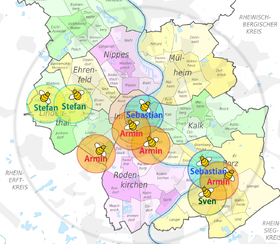
The project was founded in 2014 by Armin Behrens together with fellow hobby beekeepers. “Cologne City Honey” stands for the idea of offering honey lovers honey from their immediate neighbourhood.
Honeybees collect pollen and nectar within a radius of three kilometres. In the map section, the flight circle of the foragers of the respective bee colonies is marked.
The range of blossoms, especially in urban vegetation, is always colourful and diverse. The same goes for the flavour varieties of our blossom honeys. We offer exclusively regional honey from our own organic beekeeping in Cologne.
The bees of these beekeepers produce Cologne City Honey:
Armin Behrens
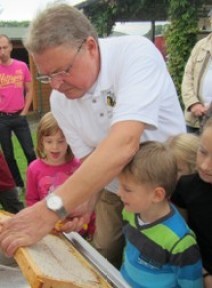
Urbach, a district of Cologne-Porz, is within walking distance of the Rhine and offers blooming gardens at the neighbouring single-family homes and an old stock of trees. From early-blooming fruit trees to acacias and lindens and on to sweet chestnut, my bees find nectar that always makes for a well-balanced sweet/spicy honey.
In Klettenberg you will find one of the largest allotment garden sites in Cologne. Here the bees find a wide variety of food and ensure the pollination of the useful and ornamental plants lovingly cultivated by the hobby gardeners. At the edge of the site grow blackberries and lindens.
In the district of Deutz, two colonies have found accommodation in the garden of friends. They are surrounded by acacias and lindens along the local streets.
Right in the city centre, in the Old Town–South on Severinsstraße, bees from four colonies forage on the trees and flowers of the Südstadt for a very spicy honey. It is astonishing how much nectar the bees find in the densely built-up Südstadt.
In Poll my bee colonies live close to the Poller Wiesen meadows between extensive blackberry hedges. This gives the honey a slightly spicy note.
Stefan Rudig
The bee forage in Lövenich and in Müngersdorf is characterised in spring by flowers and many fruit trees. This makes the honey creamy and mild. I call it COLOGNE STARTER. In late summer, the mild honey is characterised by linden trees and summer flowers and is then called THOUSAND BLOSSOMS.
Sven Kadlubek
In Zündorf I keep 10 bee colonies in my garden. By harvesting honey several times, oriented to the flowering times of the plants, I offer in the jar of the German Beekeepers’ Association: spring blossom with acacia, spring blossom with chestnut, blossom honey with rose, summer blossom with linden, summer blossom with tree of heaven.
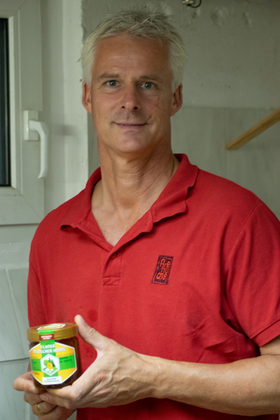
We are all members here, because in this association it’s buzzing!
De r Porz Beekeepers’ Association is committed to the environment, offers beekeeper sponsorships, guided tours in the Wahre Heide and much more. The association was founded in 1922 and bears the name “Bee Breeding Association Cologne-Porz”.
You can also learn beekeeping here. The Bee Breeding Association Cologne-Porz, together with other beekeeping associations in North Rhine-Westphalia, offers solid training to become a beekeeper based on the concept of Pia Aumeier.
Teilen