Honey Bees and German Honey
What honey bees can achieve
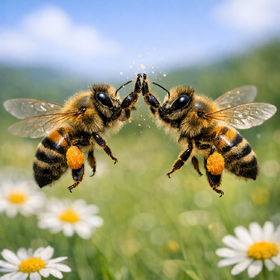
Honey has about 17 – 20% water content and consists mainly of sugars (fructose and glucose), enzymes and minerals. Honey also contains pollen and small traces of wax particles.
Approximately 80% of all flowering plants are pollinated by bees. From one bee colony, about 15 – 20 kg of honey can be harvested per year. The honey harvested by the beekeeper amounts to only about 1/3 of the honey actually produced by the bees. Most of the honey is consumed by the bees themselves, mainly as “aviation fuel”. A bee flies at about 25 – 30 km/h.
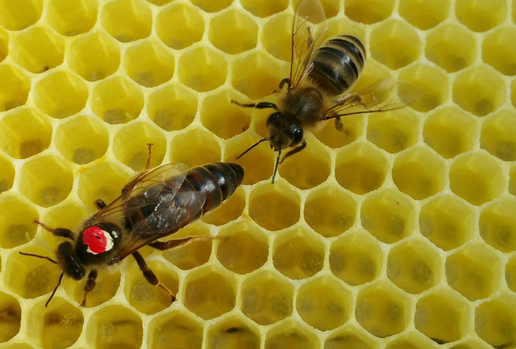
Beekeeping in Germany: For an intact nature
Beekeeping for a rich harvest
Honey bees are flower-faithful. Once the bees have identified a plant species as a good source, they will visit it until it is exhausted.
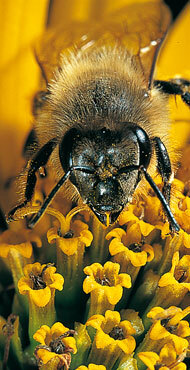
Without this activity, the yield of fruit crops would drop to a quarter.
For some apple varieties, the share of pollination by honey bees is over ninety percent.
From an overall economic perspective, the pollination performance of the honey bee exceeds the economic value of its honey production tenfold.
For the well-being of humans
Honey is much more than just a sweet spread.
More than 180 ingredients make honey a valuable helper for the human organism.
With its numerous minerals and trace elements, honey supports the human organism in coping with its daily tasks.
The natural product is of central importance here.
Only when honey is treated as gently as possible does it unfold its full effect.
The fructose and glucose are immediately converted into energy and promote performance.
In this way, honey makes an important contribution to general well-being.
Honey is a valuable source of energy and supports people’s general health.
German beekeeping at a glance
Around 90,000 beekeepers in Germany look after nearly 800,000 bee colonies.
With at least 30 – 40,000 bees per colony, this means that many billions of bees are active every day during the growing season.
About 80 percent of all native flowering plants are pollinated by honey bees.
To collect the nectar for one pound of honey, the honey bee covers a distance equivalent to three times the circumference of the earth.
Domestic bees cover only 20 – 25 percent of the total honey demand in Germany, as every German consumes an average of around 1.4 kilograms of honey per year.
We all benefit from the industrious activity of honey bees – either directly by enjoying Genuine German Honey, or indirectly by delighting in the beauty and diversity of nature.
A gentle bee is absolutely necessary given today’s dense development in Germany. With our Carnica or Buckfast bee, we have had this gentle bee for many years.
Beekeeping is important for the natural balance in the federal states of Germany.
• We can import honey to Germany, but not the pollination performance of our bees!
Information and theses of the German Beekeepers’ Association, Regional Association Rhineland:
Teilen